

• Gold fell almost 4% on Monday, September 28, its biggest one day drop since June. It is now trading near $4,120 an ounce, its lowest level in seven weeks.
• The main cause is the US bond market. The 30 year Treasury yield has reached its highest level since 2004 and the 10 year its highest since 2007, pushed up by expensive oil, sticky inflation and a Federal Reserve that has started raising rates again.
• High yields hurt gold because gold pays no interest. When a US government bond pays more than 5% a year, choosing gold instead means giving up that income.
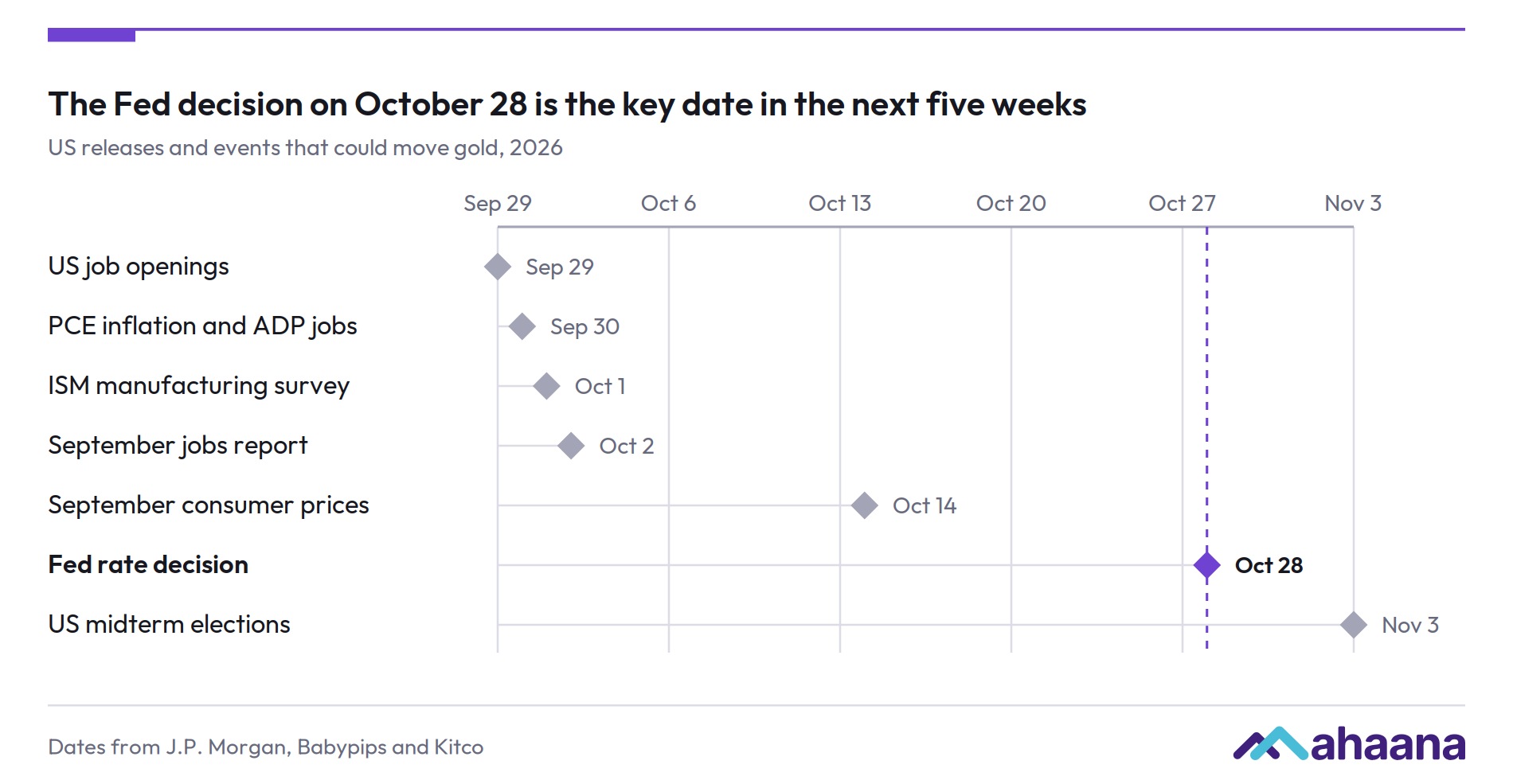
• Over the next few weeks, analysts expect more volatility and possibly a test of $4,000. This week's US inflation and jobs data, the Fed's October meeting and any news from Iran will decide the direction.
• Further out, most major banks still expect gold to be higher by mid 2027, with forecasts clustered around $5,000. These are forecasts, not guarantees.
• The value of Mahaana Gold moves with the price of gold, so this fall has affected it. Gold works best as a long term part of a diversified portfolio, and swings like this one come with owning it.
Gold had its worst day in more than three months on Monday, September 28. US gold futures fell almost 4%, their largest one day loss since June 9. Spot gold dropped to its lowest level since August 5.
The fall showed up in Pakistan the same day. One tola of gold fell by Rs12,800 to Rs438,136, based on rates from the All Pakistan Gems and Jewellers Sarafa Association.
The weakness had been building for a week. Gold opened last week near $4,383 an ounce, broke below $4,300 by Thursday and could not climb back by Friday. On Monday the selling sped up.
By Tuesday morning in Asia the price had steadied near $4,130, Reuters reported. Traders were waiting for a busy week of US inflation and jobs data before placing new bets.
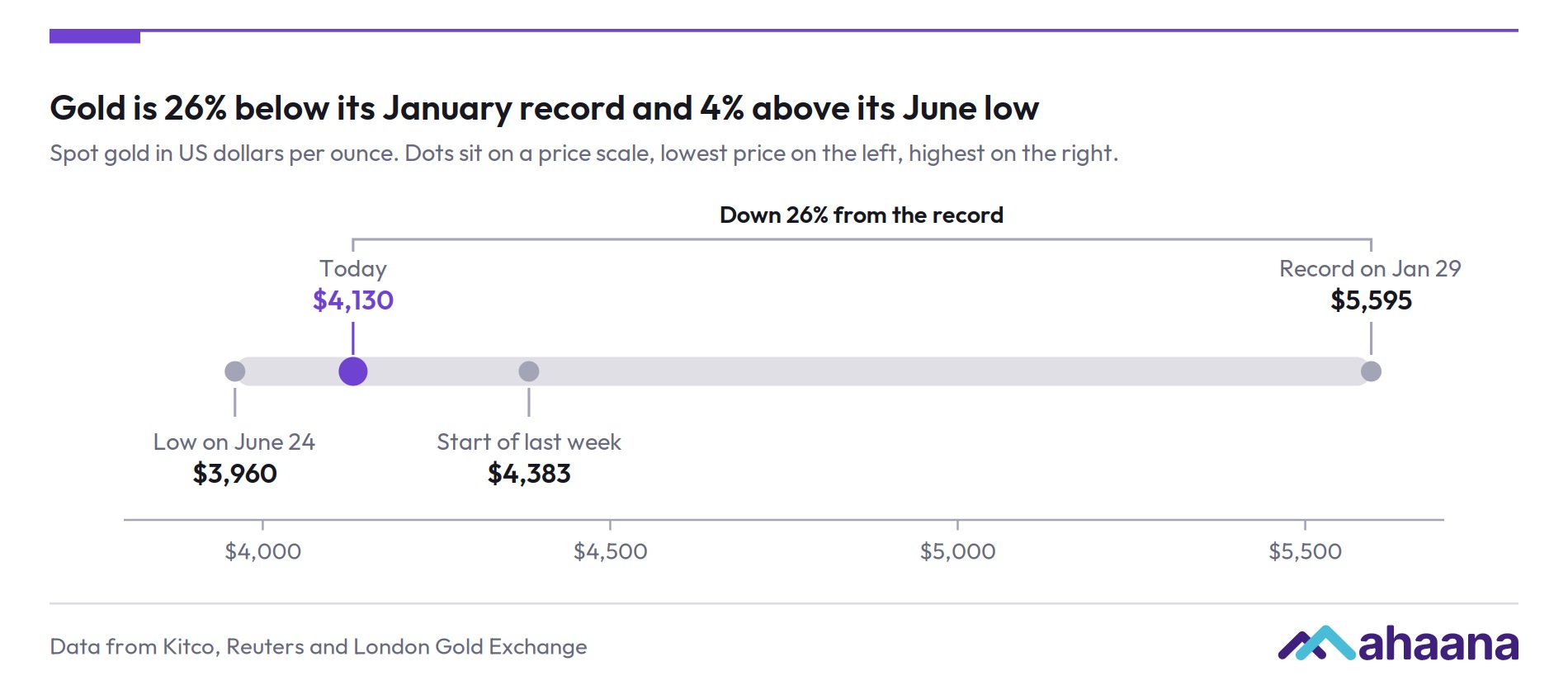
Across the whole year, gold is now closer to the bottom of its range than the top. It set a record of about $5,594 in January so today's price is roughly 26% lower. It is down 4.2% so far this year, but still above the June and July lows near $3,940 that is treated as a crucial support zone.
Gold is falling because US government bonds now pay more than they have in almost 20 years. The chain that got them there starts with a war.
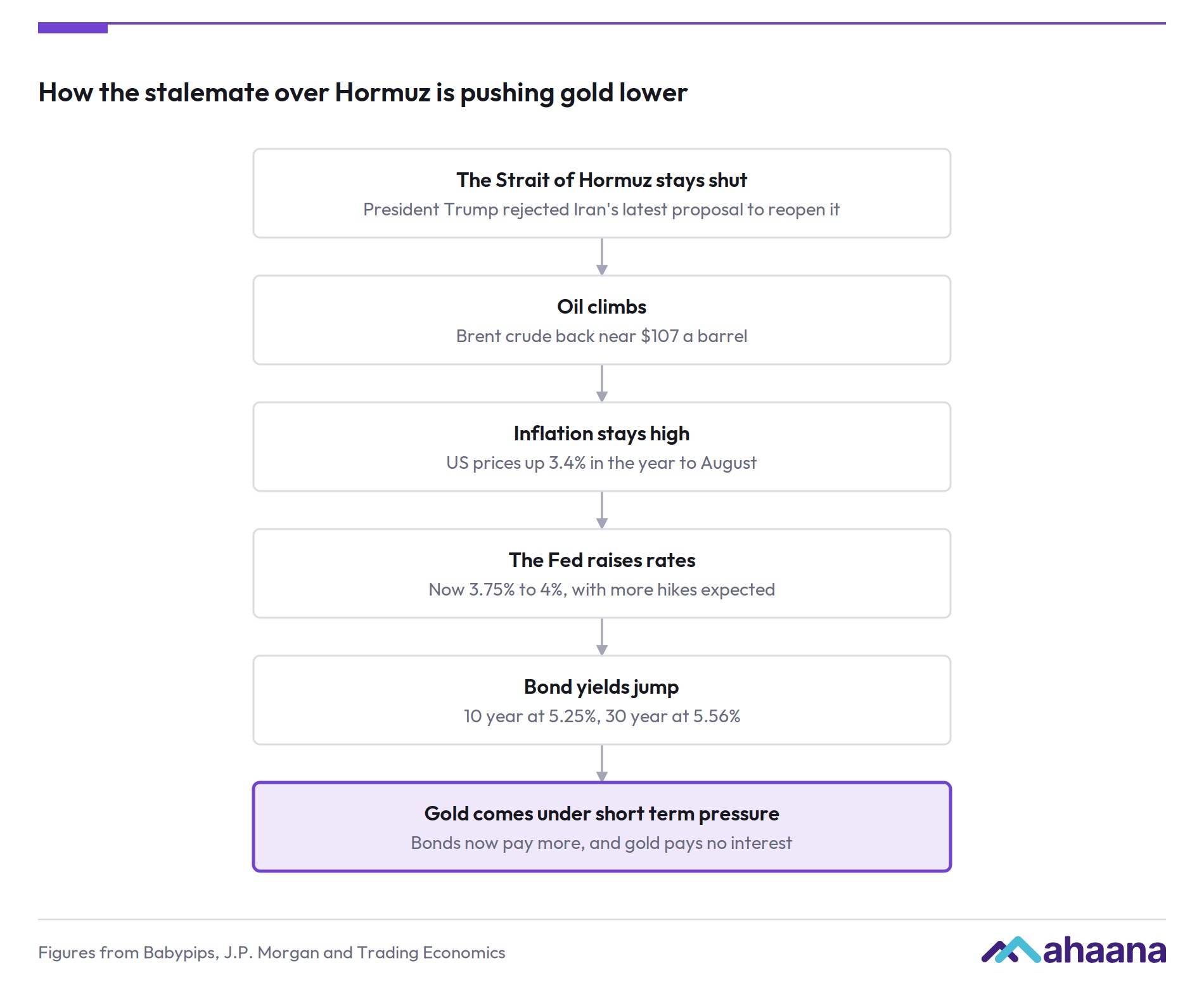
The war between the US and Iran is in its seventh month, and the Strait of Hormuz remains effectively closed. Before the conflict, roughly a fifth of the world's crude oil and liquefied natural gas passed through it.
Over the weekend, President Trump rejected Iran's latest proposal to reopen the strait, and Brent crude climbed back toward $107 a barrel on Monday. Iranian officials have since cast doubt on reaching a deal before the US midterm elections in November.
Expensive energy is feeding into prices. US inflation was 3.4% in the year to August, and prices rose 0.4% in August alone, the biggest monthly jump in four months.
On September 16 the Federal Reserve raised its policy rate by a quarter point to a range of 3.75% to 4%. It was the first hike since July 2023, and all 12 voting members backed it.
Sixteen of 18 Fed officials now expect another hike before the end of this year. Their median projection for the policy rate at the end of 2026 rose to 4.1%, up from 3.8% in June.
Markets have moved further than the Fed. Traders now put the odds of another hike at the October 28 meeting at 72.5%, up from 57.6% a week earlier.
Bond investors sold hard. On Monday the 10 year Treasury yield reached 5.21%, its highest since 2007, while the 30 year hit about 5.48%, a level not seen since 2004. By Tuesday the 10 year stood at 5.25% and the 30 year at 5.56%.
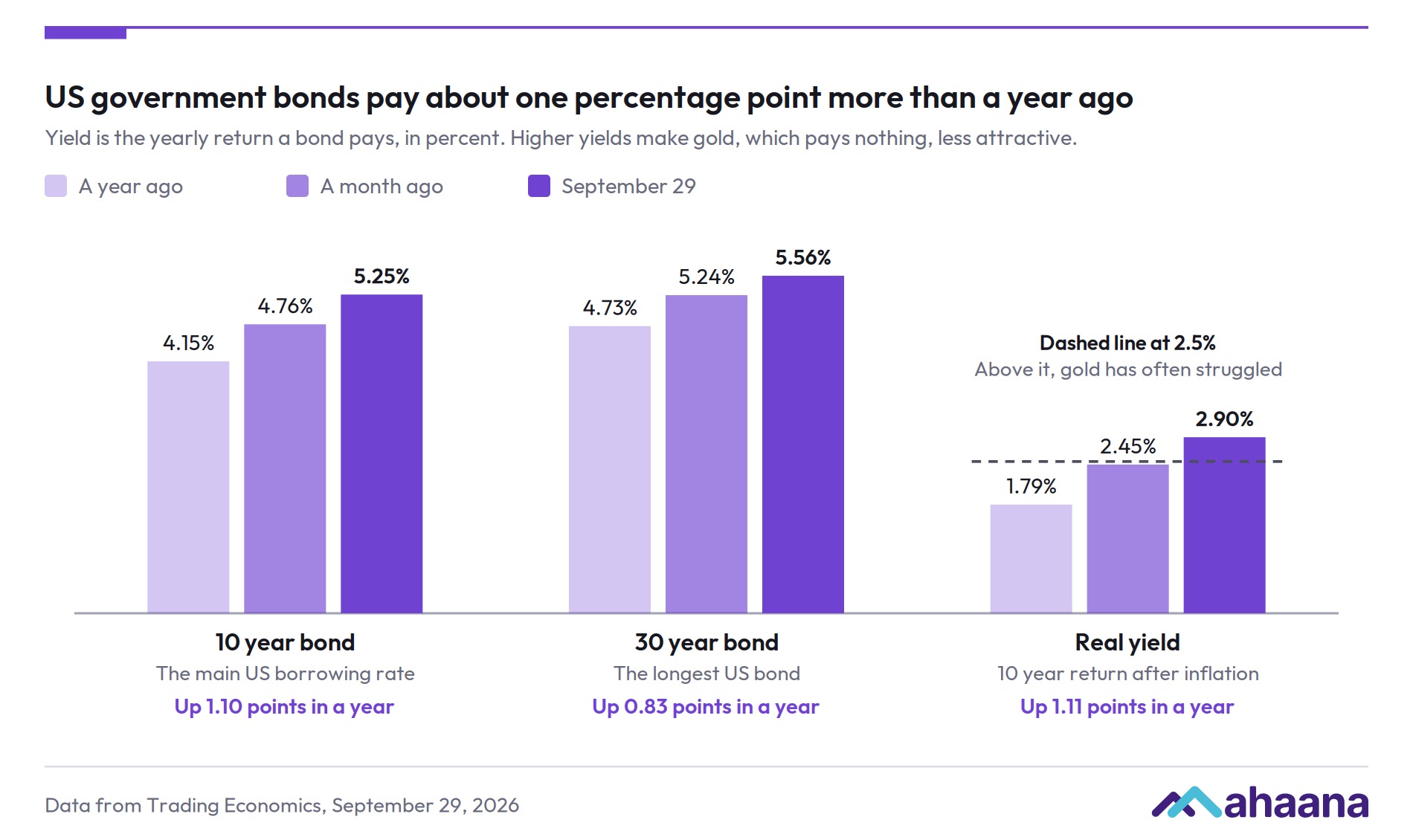
Oil is only part of the story. Strong US growth data, heavy government borrowing and a steady flood of new bonds are also pushing yields up.
Gold pays no interest. When a 10 year US government bond pays 5.25% a year, every dollar held in gold gives up that income, and some investors decide the swap is no longer worth making.
The measure that matters most is the real yield, the return on a bond after inflation. The 10 year inflation protected Treasury yield was 2.90% on Tuesday, up from about 1.79% a year ago. The World Gold Council has flagged 2.5% as the level that has historically raised the cost of holding gold and deepened selling from gold funds.
The selling is coming mostly from Western investors who trade on interest rates. The buying is coming from central banks and from China, and neither has stopped.
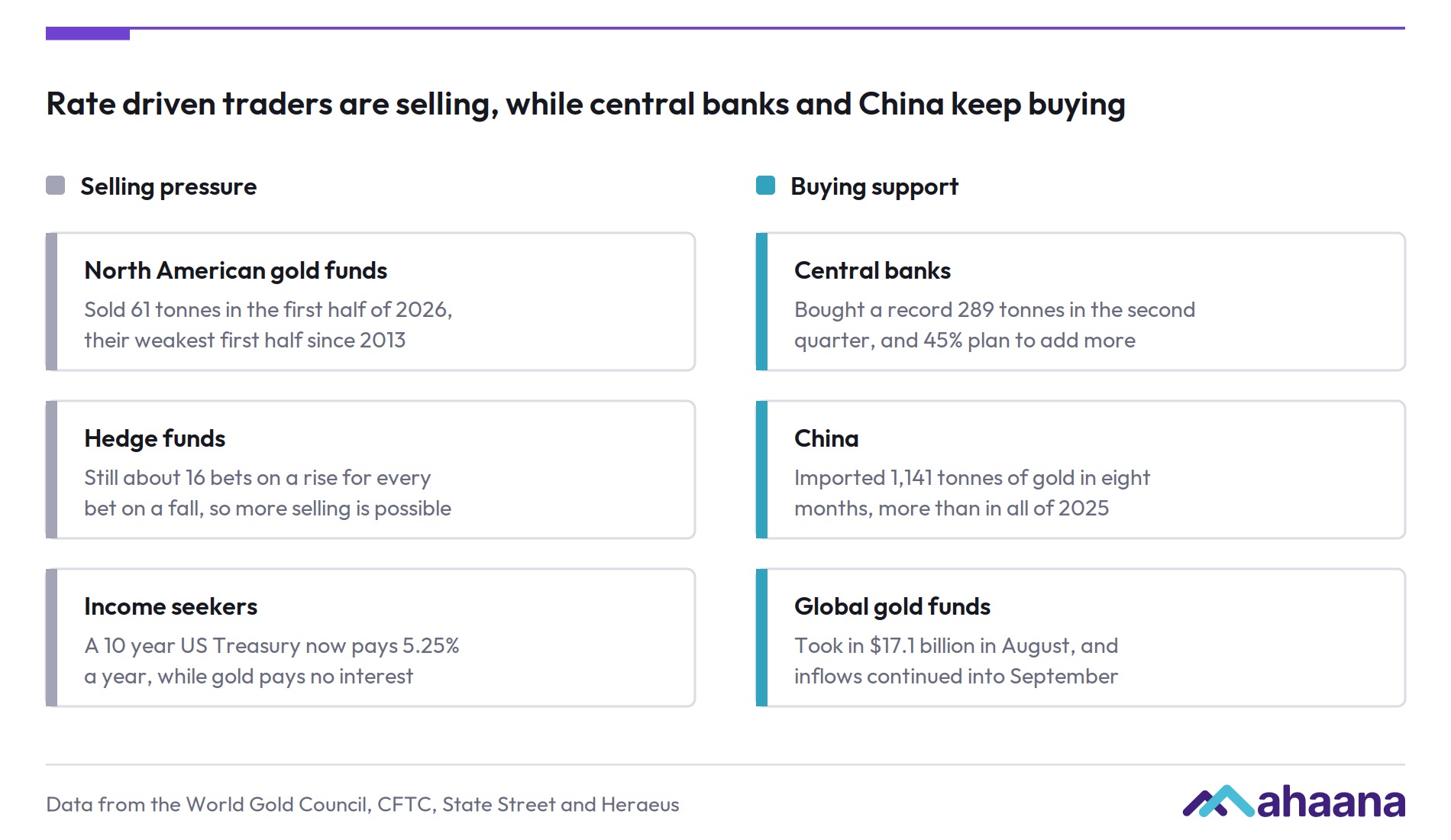
Gold funds in North America lost 61 tonnes in the first half of 2026, their weakest first half since 2013, according to World Gold Council data. The Council linked the selling to hawkish Fed signals, inflation worries tied to the Iran war and a stronger dollar.
That selling reversed in August. Global gold funds took in $17.1 billion that month and US funds $7.9 billion, their strongest month since September 2025, State Street's Aakash Doshi told Kitco. He said the inflows continued into September.
Speculators have trimmed their bets but not abandoned them. As of September 22, money managers held 135,699 long gold futures contracts against just 8,310 short ones, based on CFTC data. That is about 16 bets on a rise for every bet on a fall.
This matters for the weeks ahead. A crowded bet on higher prices can unwind quickly when prices fall, and this data was collected before Monday's drop.
Central banks bought a record 289 tonnes of gold in the second quarter, up from 57 tonnes in the first, according to the World Gold Council. A record 45% of central banks surveyed by the Council plan to add to their gold reserves.
China's central bank added another 20 tonnes in August. Central banks do not buy gold for a quick profit, so their demand tends to hold up when prices fall.
Buyers in China outside the central bank are buying even more. China imported 1,141 tonnes of gold in the first eight months of 2026, already more than the 940 tonnes it brought in during all of 2025.
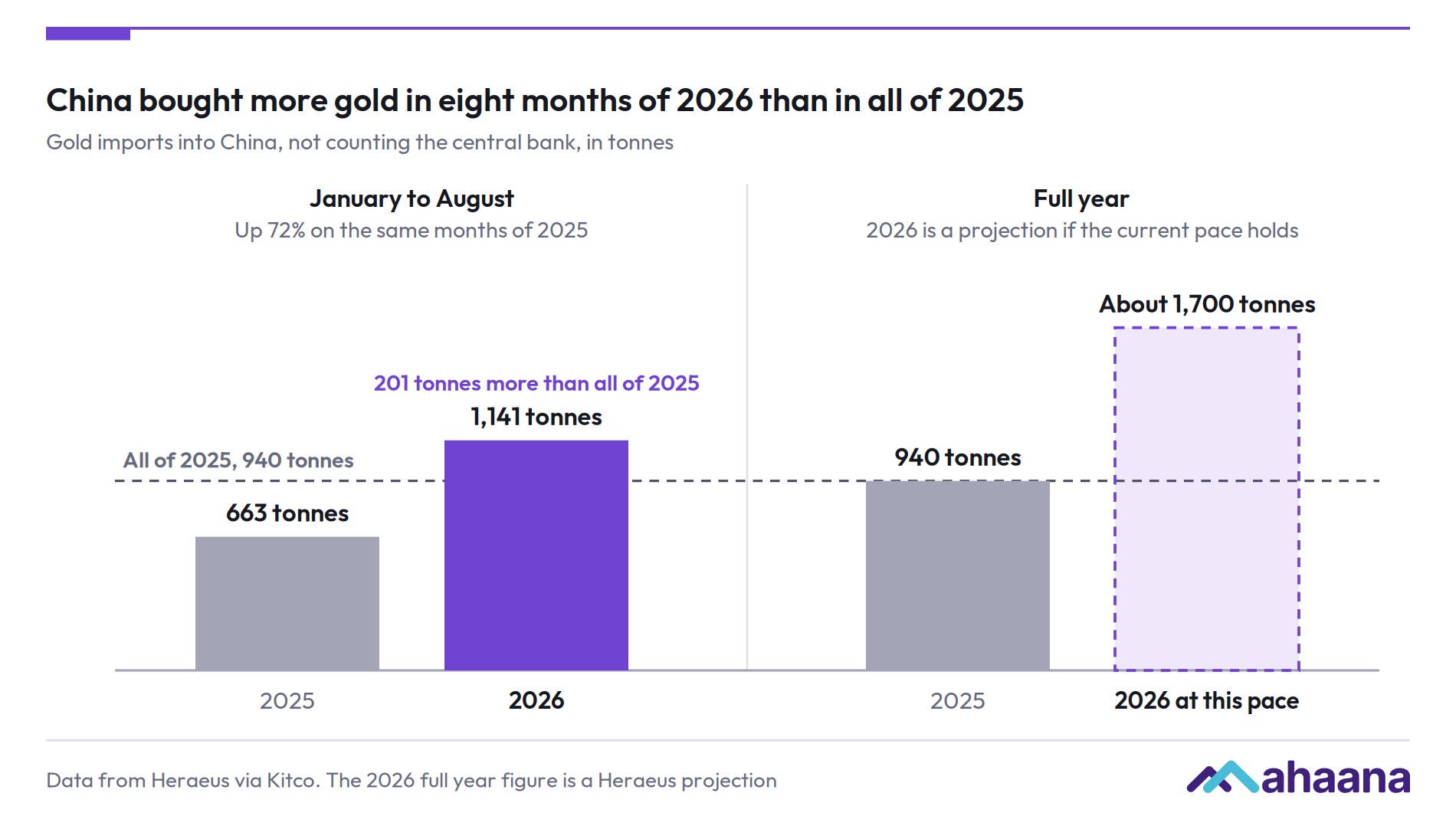
At this pace, China's imports would reach about 1,700 tonnes this year, the highest this decade, Heraeus said. One soft spot is India, where a monsoon about 15% below normal could weigh on rural buying during the festival and wedding season.
Most analysts expect gold to stay under pressure for the next few weeks and to be higher by the middle of 2027. The path between those two points runs through US inflation data, the Fed's October meeting and the talks over Hormuz.
The first line analysts are watching is $4,000. State Street's Aakash Doshi said rising yields could push gold back toward $4,000 within a week, but he expects that level to hold.
Société Générale's technical analysts see the trend pointing lower unless gold climbs back above about $4,315. Below that, they see support near $4,095 and then a crucial zone at $3,960 to $3,940, the lows of June and July.
Saxo Bank's Ole Hansen said gold's resilience faces its "toughest test yet." He warned that if tighter financial conditions push investors to raise cash, gold's deep liquidity could make it one of the first things they sell, even though longer term risks still support it.
This week's data will decide a lot. Analysts at Kotak Securities said a hot inflation reading followed by strong jobs numbers could open the way toward $4,000. A rebound, they said, would likely need softer jobs data, a more patient Fed or a diplomatic breakthrough that pulls oil lower.
Partly. The pressure from interest rates looks largely reflected in prices, but two other risks have not played out yet.
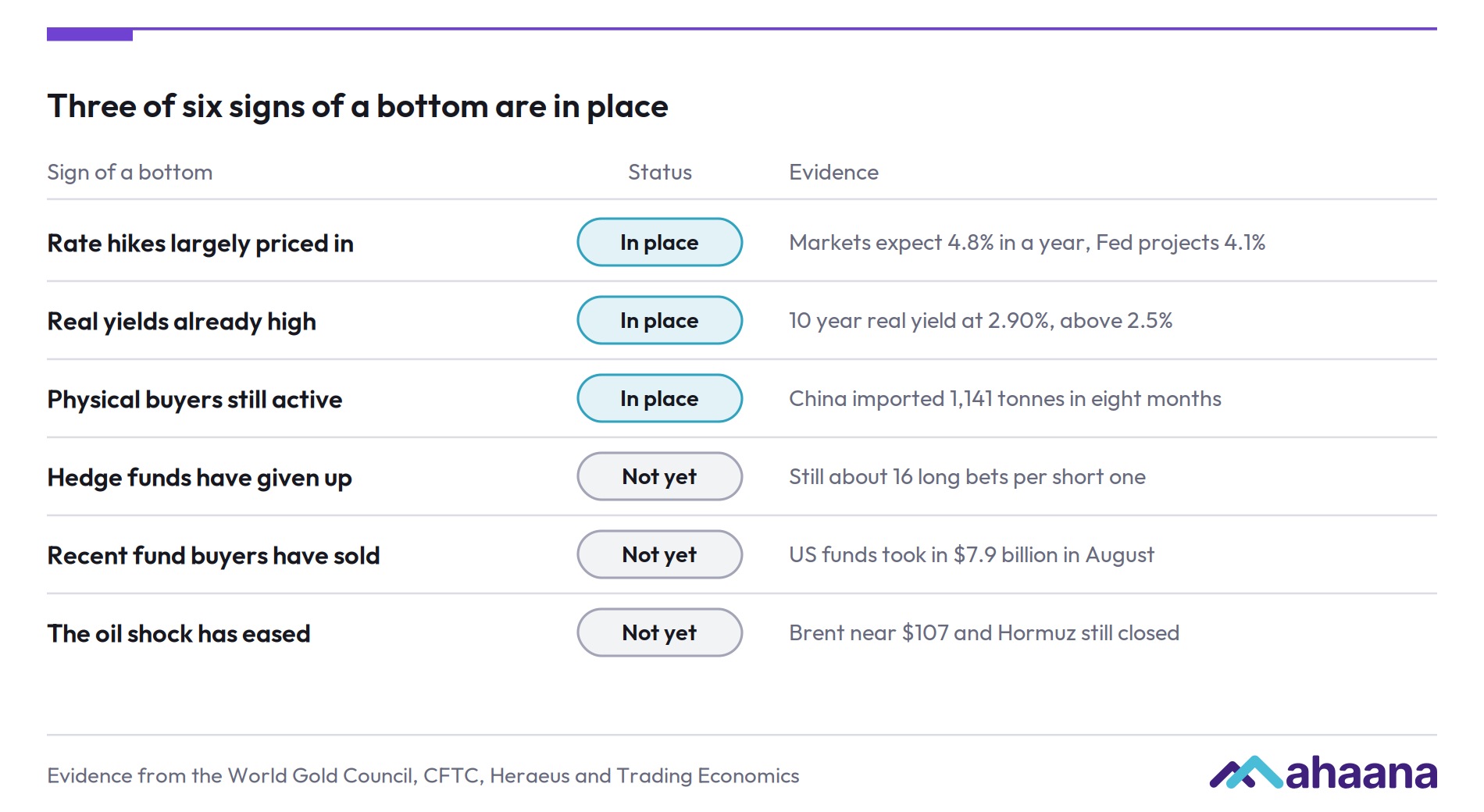
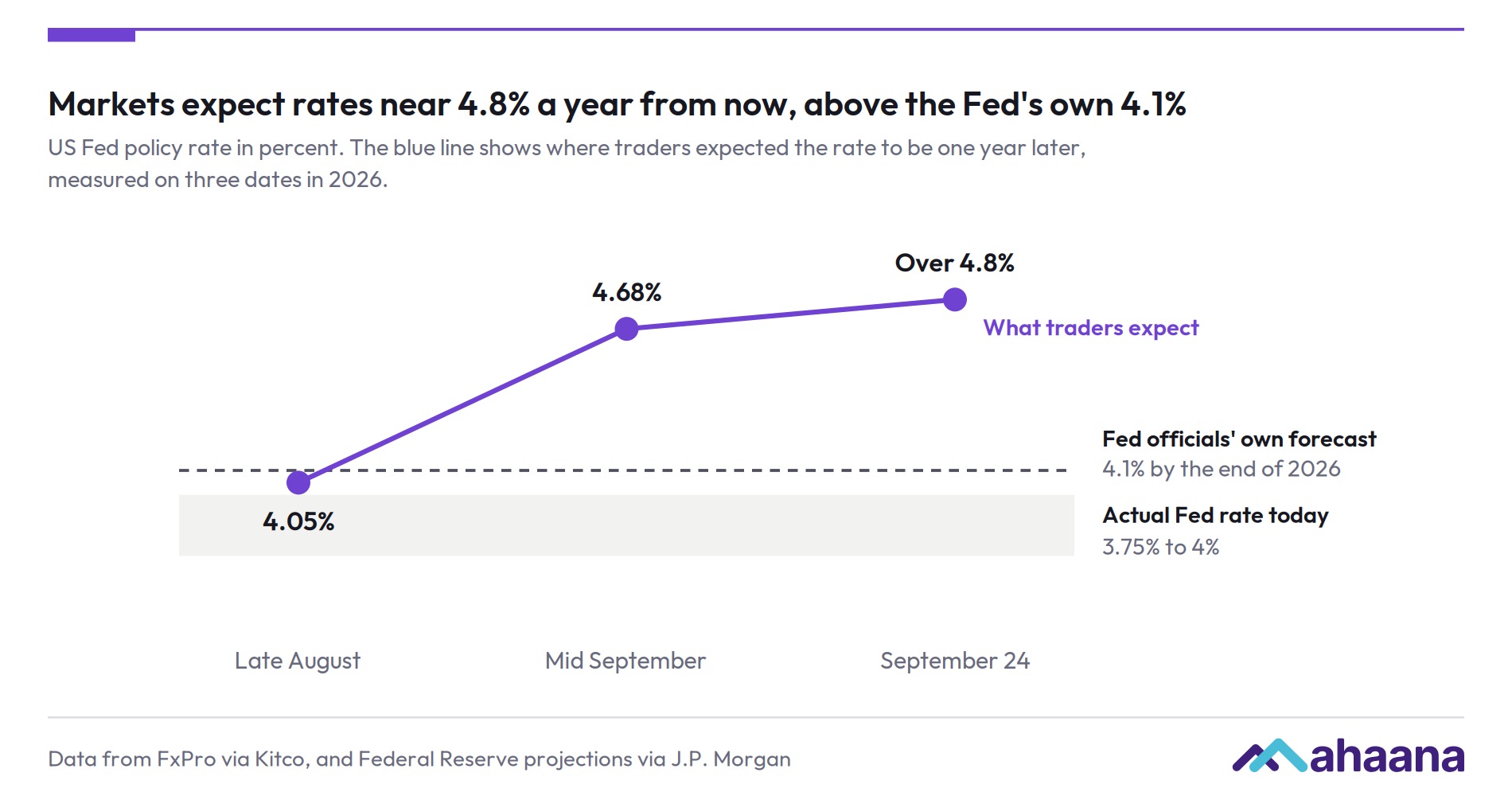
Markets already expect US rates near 4.8% a year from now, above the Fed's own 4.1% projection, so a lot of bad news on rates is in the price. Doshi described the recent selling as a reaction to peak market hawkishness, with two extra rate hikes priced in since mid August.
The other risks are still live. Hedge funds were still heavily bet on higher prices as of September 22, and many investors who bought gold funds in August are now sitting on losses, which leaves room for more selling. Oil is the bigger unknown, and BMO said its positive view holds unless oil prices spike much further.
A bottom often shows up when gold stops falling on bad news. If a hot inflation reading or a strong jobs report fails to push gold lower, that would be an early sign the selling is running out.
Every major bank forecast we found sits above today's price. Targets for late 2026 cluster between $4,450 and $5,100 an ounce, and most targets for 2027 fall between $5,000 and $5,600.
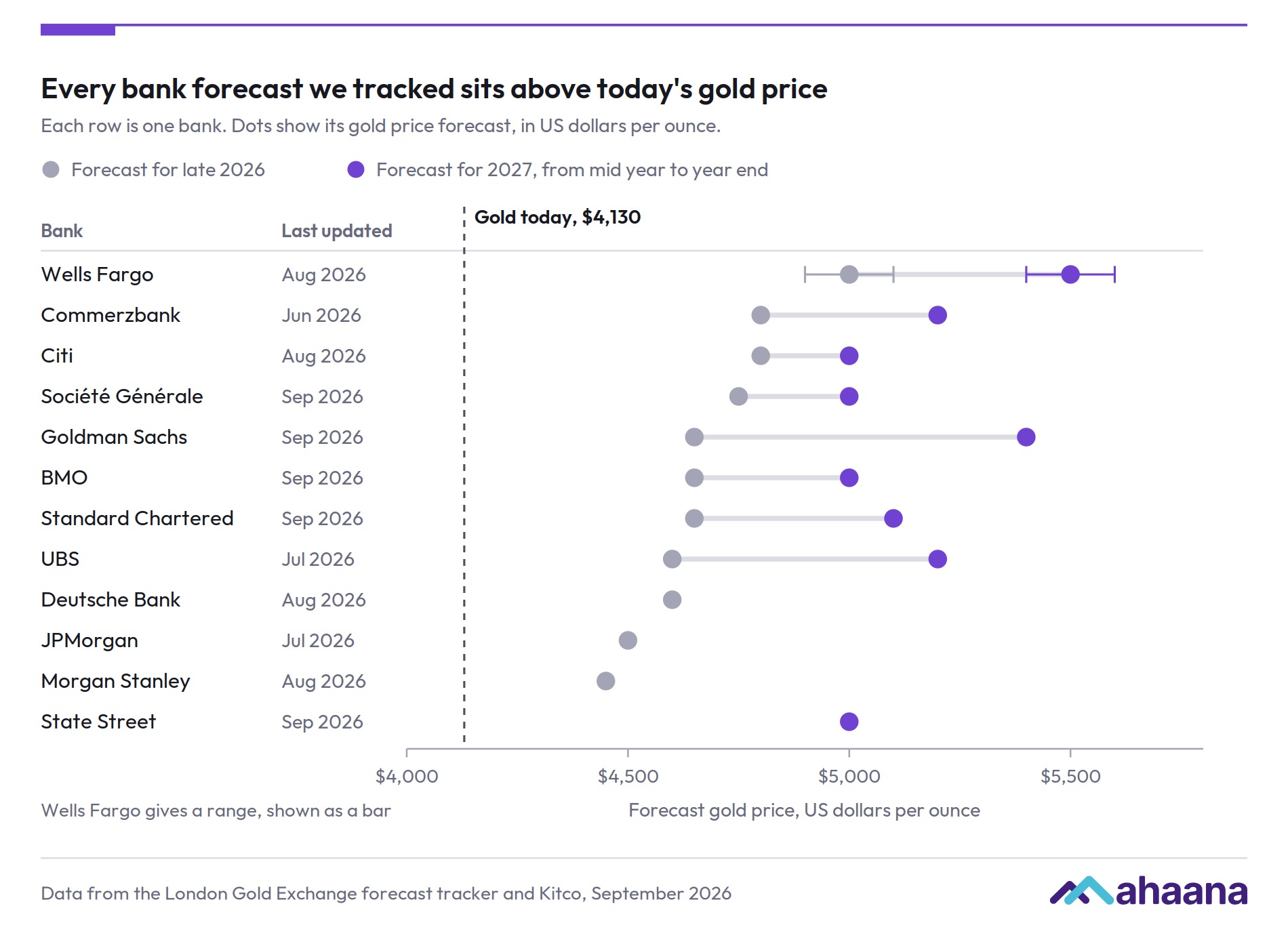
The newest updates came this week. BMO trimmed its fourth quarter forecast to $4,650 but raised its long term price assumption by 29% to $4,000, arguing that monetary debasement and Chinese demand now matter more than traditional yield drivers. Goldman Sachs cut its end 2026 fair value to $4,650 from $4,900 after the Fed hike, but kept its $5,400 target for the end of 2027.
Not everyone is as positive. The World Gold Council expects gold to trade around $4,100, give or take 5%, in the second half of this year. Forecasts also have a mixed record, and the average analyst forecast for 2025 missed the actual gold price by about 25%.
Deep falls are not new for gold. The metal has dropped by 29% or more at least four times since the 1970s, and those falls ended in very different ways.
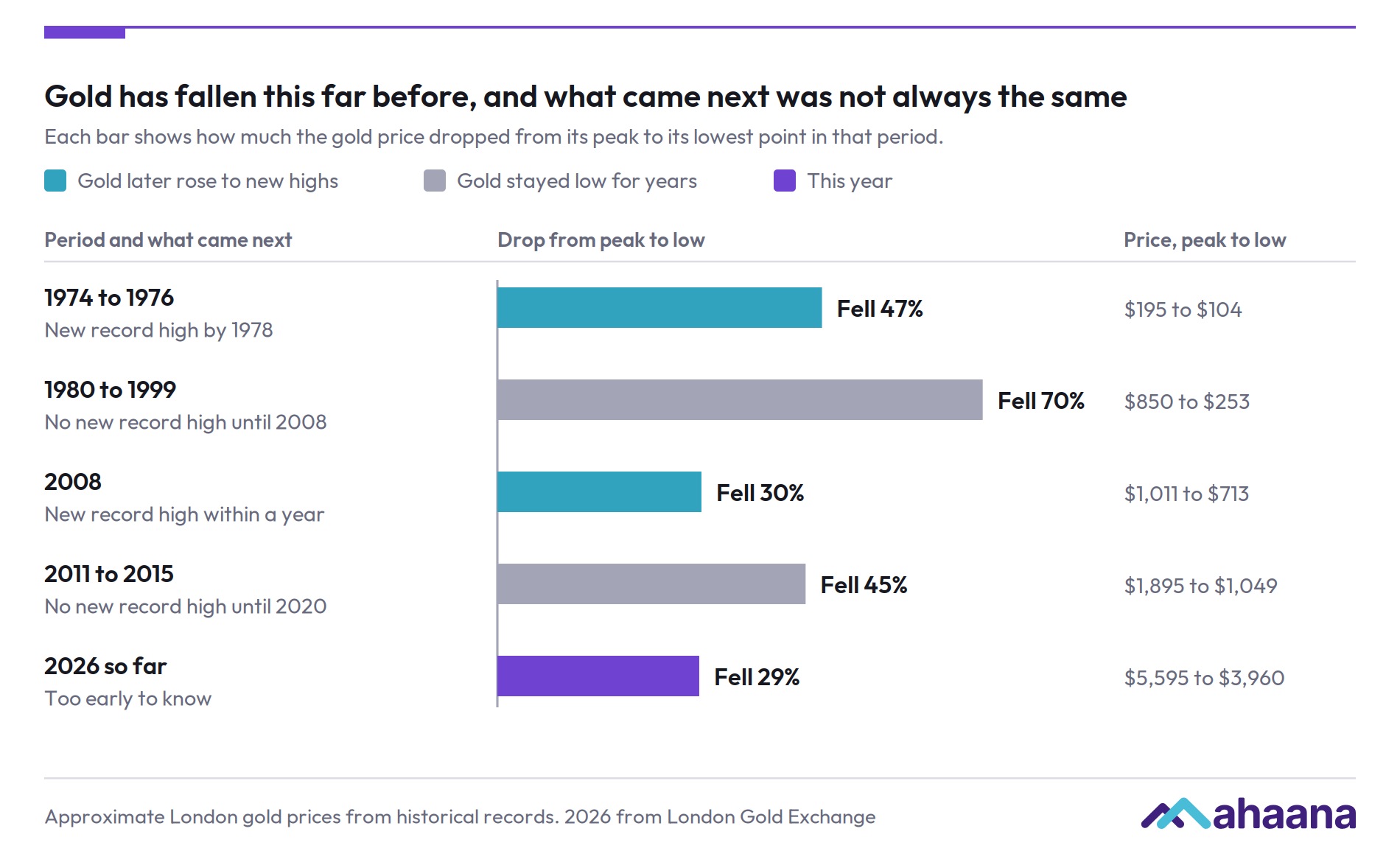
The falls that ended in 1976 and 2008 were pauses inside longer rallies, and gold went on to new records. The falls that began in 1980 and 2011 turned into declines that lasted years, as real interest rates climbed, and in the 1990s central banks were net sellers of gold.
Today real yields are high again, but central banks are on the other side of the trade. They bought 863 tonnes in 2025, and the World Gold Council expects 700 to 900 tonnes in 2026.
If you invested in Mahaana Gold in its first weeks, you are likely looking at a loss today. The fund launched on September 11, and gold has fallen since then.
The Mahaana Islamic Gold Fund is designed to move with the price of gold in rupees. When gold falls, the fund's value falls with it, and when gold rises, the fund rises too.
Two things set that rupee price, the dollar price of gold and the rupee's exchange rate. On Monday a tola fell 2.8% in Pakistan while the international price fell about 3%, because the rupee barely moved. The interbank rate stood at Rs277.35 per dollar that day.
Falls like this one come with owning gold. This year alone, gold dropped about 29% from its January record to its June low and then rallied about 10% in August. Analysts expect more swings in the weeks ahead.
A few principles can help while prices move around.
If you have questions about your investment, the Mahaana support team is available to help.
Disclaimer: This article is for information and education only and is not investment advice. Forecasts quoted here are the views of third party analysts, not Mahaana, and they can be wrong.
